


Tire Import Certification Requirements 2026: The Complete Guide for Non-Western Markets
Tire Import Certification Requirements 2026: The Complete Guide for Non-Western Markets
By Goldtop: China Tire B2B Export Specialists
Picture this: a 40-foot container of Chinese TBR tires sits at Apapa Port, Lagos, for 34 days because nobody activated SONCAP before shipment. Demurrage charges alone exceed the margin on the entire order. The certificate fee is a rounding error. The clearance failure is what turns a profitable quarter into a write-off.
The most expensive line item in any tire import budget is not the unit price. It is the shipment that never clears. Tire import certification requirements decide whether your cargo becomes revenue or a storage bill — from PCR into Lagos to OTR into Jakarta. In Brazil, passenger tire import tax rose from 25% to 30% on November 9, 2026 (Source: Brazil Gecex, Nov 2026), compressing landed costs everywhere. But the importer without valid INMETRO homologation is not competing on margin at all. He is competing for a customs release date.
If you have watched a container sit while your buyer's warehouse ran empty, you already know certification is not clerical work. This guide maps certification requirements for tire imports across Africa, the Gulf, Latin America, and Southeast Asia, then ends with a five-step audit to run before you pay a deposit: why approval is a margin decision, the 2026–2027 market map, how DOT, ECE, GCC and INMETRO compare, what customs reads on the sidewall, and how to spot a fake certificate.
Key Takeaways
- Tire import certification requirements are a margin decision: an uncleared container can accrue demurrage exceeding the order's total profit within weeks.
- INMETRO (Brazil) runs a 3–6 month approval cycle with ~4-year validity and annual review (Source: INMETRO). SONCAP (Nigeria) uses a dual PC + SC structure, with the SC issued per shipment (Source: SON).
- GCC G-Mark covers seven Gulf states under GSO 2470/2528, certificates valid 3 years (Source: GSO); GSO added rolling-noise and wet-grip limits from 2021 (Source: GSO). Mexico's NOM-086-SCFI is mandatory and bans used tires (Source: Mexico import rules).
- DOT or ECE reports cannot replace INMETRO: Brazil requires accredited-lab testing and a Brazilian legal entity to hold the certificate (Source: INMETRO).
- Verify certificates against the issuing authority's database — DOT via NHTSA, E-mark via UNECE, G-Mark via GSO tracking — and match factory, brand, and size before signing (Source: NHTSA; UNECE; GSO).
Why Tire Import Certification Requirements Are a Margin Decision
Every purchase order carries a hidden second price: the cost of getting the container released. When tire import certification requirements are handled correctly, that cost stays invisible. This is not paperwork. It is pricing.
What Non-Compliance Actually Costs
Take one 20-foot container of TBR tires, FOB value $60,000, 12% gross margin — roughly $7,200 in profit if all goes well. Now hold that container at a congested port.
Demurrage and detention at major West African and South Asian ports run $100–200 per container per day after free time (Source: port tariff surveys, 2026). At day 34 — the Apapa scenario above — that is $3,400–6,800 in port charges alone, before buyer penalties or re-testing fees. What the hold costs, in order:
- Port hold and demurrage: charges accrue daily until documents are corrected or cargo is re-exported.
- Administrative fines: most conformity regimes levy penalties per shipment or per day of non-conformity.
- Forced re-export or destruction: customs refuses release entirely, at the importer's expense.
- Importer blacklisting: repeat failures trigger enhanced inspection on every future shipment.
The Apapa hold that erased a quarter. A Lagos fleet-tire importer booked eight containers of Chinese drive-axle TBR in Q1 2026 at a thin 10% margin to win a transport tender. The supplier shipped before SONCAP's Product Certificate was activated. The first container sat 34 days at Apapa; the rest queued behind it. By the time shipment-level Certificates of Conformity were issued, demurrage and late-delivery penalties consumed the entire projected contract profit. He now activates every SONCAP document before booking confirmation, not after.
How INMETRO & SONCAP Protect Certified Importers
The same barrier works in your favor once you are inside. Long approval cycles keep casual competitors out of your channel.
Brazil's INMETRO homologation runs a 3–6 month cycle per brand and size family, with certificates holding ~4-year validity subject to annual review (Source: INMETRO). A distributor starting in January sells compliant stock by Q3; a competitor hearing about the opportunity in Q4 is still waiting on lab slots. Nigeria's SONCAP reinforces the same dynamic: importers who hold an active Product Certificate and maintain test reports generate shipment-level Certificates of Conformity in days, while new entrants face the full registration runway (Source: SON).
This matters more in 2026 because Brazil imposed anti-dumping duties of $1.25–1.77/kg on Chinese automotive tires from December 2025 (Source: Brazil trade remedies, Dec 2025). When duty stacks squeeze margin everywhere, clearing in 48 hours instead of 34 days is no longer a speed advantage. It is the difference between booking the order and eating the demurrage.
If your next shipment is headed to a SONCAP, GCC or INMETRO destination, the approval cycle should start with the supplier — not after the deposit. Goldtop keeps those files ready per factory and per brand. Reservation Now — MOQ is one 20-foot container.
Tire Import Certification Requirements by Market: 2026–2027 Map
There is no single global checklist. Nigeria, Brazil and Indonesia each run their own scheme — and enforce on different rhythms.
West & East Africa — SONCAP (Nigeria) and PVOC (Kenya, Tanzania, Uganda)
Nigeria runs SONCAP with a dual-certificate structure. A Product Certificate (PC) is registered against the brand and product range; a Certificate of Conformity (SC) is issued per shipment (Source: SON). Kenya, Tanzania, and Uganda operate Pre-Export Verification of Conformity (PVOC) programs with similar pre-shipment logic. Document execution detail — Form M, PAAR, and SC sequencing — is a separate operational layer; see the Nigeria SONCAP document checklist rather than treating it as a purchasing afterthought.
For demand context, see the Africa and Middle East tire import trends.
The Gulf & Middle East — GCC G-Mark and Saudi SASO/SABER
The GCC Standardization Organization administers the G-Mark scheme across seven Gulf states, built on GSO technical regulations 2470 and 2528, with certificates valid 3 years (Source: GSO, www.gso.org.sa). Saudi Arabia adds SABER platform registration referencing SASO requirements before port release.
Two details catch importers off guard. GSO introduced rolling-noise and wet-grip performance limits from 2021 (Source: GSO), so older test reports may not satisfy current reviews. And the certificate must map to a specific factory, brand, and size/tread range — a G-Mark covering 205/55R16 PCR does not authorize 315/80R22.5 TBR from the same plant.
Latin America — INMETRO (Brazil) and NOM (Mexico)
Brazil dominates regional tire import certification requirements through INMETRO, which mandates homologation for PCR and LTR via accredited laboratories, with the certificate held by a Brazilian legal entity (Source: INMETRO). The 3–6 month cycle and ~4-year validity make it both the steepest barrier and the deepest competitive shield in Latin America.
Mexico's NOM-086-SCFI is mandatory for tire imports and bans used tires (Source: Mexico import rules). Colombian and Peruvian customs often accept INMETRO-aligned test reports more readily than first-time local approvals — multi-market distributors anchor compliance on the Brazilian file and branch outward. For category-level demand sizing, see the China tire emerging markets growth 2026.
Southeast Asia — SNI (Indonesia), TISI (Thailand), SIRIM (Malaysia)
Indonesia's SNI is mandatory for imported tires: 3–6 month certification cycle, 4-year validity (Source: SNI). A July 2025 update revised product-standard requirements with a transition window closing July 16, 2026 (Source: SNI) — re-confirm file status if shipping under pre-transition reports. Thailand's TISI licensing and Malaysia's SIRIM certification follow similar national-approval logic. Budget three separate files for three ASEAN markets, not one regional pass.
Why DOT and ECE Still Matter Outside Western Markets
DOT and ECE approvals belong in your dossier even if you never ship to Houston or Rotterdam. Many conformity schemes reference ECE or DOT test reports as acceptable supporting evidence. An E-marked tire carries laboratory data on rolling resistance, wet grip, noise, and high-speed performance — a G-Mark or SNI reviewer can read that data without re-testing. Second, international approvals signal factory capability: a plant holding DOT registration and ECE type approvals has survived two of the industry's most demanding regulatory audits.
DOT vs ECE vs GCC vs INMETRO: A Side-by-Side Comparison
DOT, ECE, G-Mark and INMETRO get confused constantly. They are not four versions of the same approval.
Type Approval vs Conformity Assessment — Two Different Systems
Type approval (DOT, ECE) approves a tire design against a regulation; conformity assessment (G-Mark, INMETRO, SONCAP, SNI) checks whether a specific shipment from a specific factory meets the destination's rules. A DOT code does not satisfy SONCAP, and an E-mark does not replace INMETRO.
Put formally: DOT (United States) and ECE (UNECE) are type-approval systems — the approval follows the design. GCC G-Mark, INMETRO, SONCAP, and SNI are conformity-assessment systems — they ask whether a specific shipment conforms. Assume otherwise, and the container waits.
What Transfers Between Markets, and What Never Does
ISO 9001 scope, factory audit reports, and third-party physical-property test data travel well across schemes. What never transfers is the approval itself. INMETRO does not accept DOT or ECE reports as direct substitutes — it requires INMETRO-accredited lab testing and a Brazilian legal entity to hold the certificate (Source: INMETRO). GSO added rolling-noise and wet-grip limits from 2021 (Source: GSO), so pre-2021 ECE reports may fall outside current G-Mark scope. And every scheme demands that the certificate cover the exact factory, brand, and size/tread range shipped.
DOT and ECE are type-approval systems with multi-year validity, while GCC G-Mark, INMETRO, and SONCAP are conformity-assessment schemes with validity from per-shipment to about 4 years (Sources: GSO, INMETRO, SON).
| Certification | Market / Legal Basis | Factory Audit | Typical Validity | Label Language | Typical Timeline | Cost Level |
|---|---|---|---|---|---|---|
| DOT | US (NHTSA / FMVSS 139) | Plant registration + self-cert | Continuous w/ annual reporting | English (DOT code molded) | Weeks (plant code + test data) | Low–Medium |
| ECE (E-mark) | UNECE (R30/R54/R75/R117) | Technical service audit | 3–5 years per approval | ECE symbol + approval no. | 2–4 months per type | Medium |
| GCC G-Mark | GSO 2470/2528 (7 states) | Often required per manufacturer | 3 years (Source: GSO) | Arabic + English | 4–8 weeks post-test reports | Medium |
| INMETRO | Brazil (Portaria INMETRO) | INMETRO-accredited audit | ~4 yrs + annual review (Source: INMETRO) | Portuguese (INMETRO mark) | 3–6 months (Source: INMETRO) | High |
| SONCAP | Nigeria (SON Act) | Manufacturer/brand registration | PC renewable; SC per shipment (Source: SON) | English | 3–6 weeks first registration | Medium |
PCR vs TBR vs OTR certification difference matrix:
| Aspect | PCR (Passenger) | TBR (Truck & Bus Radial) | OTR (Off-The-Road) |
|---|---|---|---|
| National-scheme coverage | Mandatory in nearly all | Mandatory in most markets | Often exempt or lighter-touch |
| Primary test focus | High-speed, wet grip, noise | Load endurance, bead strength | Cut/chip resistance, heat build-up |
| Labeling scrutiny | Highest (consumer-facing) | Moderate | Lowest (equipment docs) |
| Western AD/CVD exposure | Highest (EU AD733, load index ≤121; Source: EU AD733 scope, 2026) | Varies (EAEU TBR AD active; Source: EAEU) | Largely outside Western AD cases (Source: US AD-CVD orders, 2026) |
| Common trap | Assuming E-mark satisfies INMETRO or G-Mark | Using PCR-range G-Mark for TBR sizes | Treating OTR as "no certification needed" |
The Pre-Order Compliance Checklist for Tire Importers
You cannot verify tire import certification requirements after the container sails. These three checkpoints belong in your purchase-order workflow.
Documents to Demand Before You Pay a Deposit
Request five items and hold the proforma until all five arrive:
- Valid conformity certificate for your destination (INMETRO, G-Mark, SONCAP PC, SNI, or equivalent) with number, issue date, and expiry visible.
- Matching test reports from an accredited lab, within the scheme's recency window, covering the exact sizes ordered.
- ISO 9001 certificate whose scope explicitly covers tire manufacturing at the named factory — not a trading company's umbrella.
- Factory registration evidence: DOT plant code, GSO manufacturer registration, or entry in the destination scheme's registry.
- Prior shipment records to your destination — redacted bills of lading are fine; you want proof this factory has cleared the same scheme before.
Sidewall Markings and Labeling That Customs Actually Inspect
Customs officers do not read proforma invoices at the container door — they read sidewalls. For G-Mark destinations, the conformity symbol must be permanently molded on the sidewall with character height ≥5 mm, and labels must be Arabic + English bilingual (Source: GSO). US-adjacent flows check the molded DOT code against NHTSA plant records (Source: NHTSA, www.nhtsa.gov). ECE markets verify the E-mark approval number including country code. Brazil checks the INMETRO mark and Portuguese labeling against the homologation file. Any regulatory mark printed on a sticker rather than molded into the rubber is a red flag — legitimate marks are permanent by design.
PCR vs TBR vs OTR — Category-Specific Certification Traps
Each category carries a different certification profile, and one file rarely covers all three.
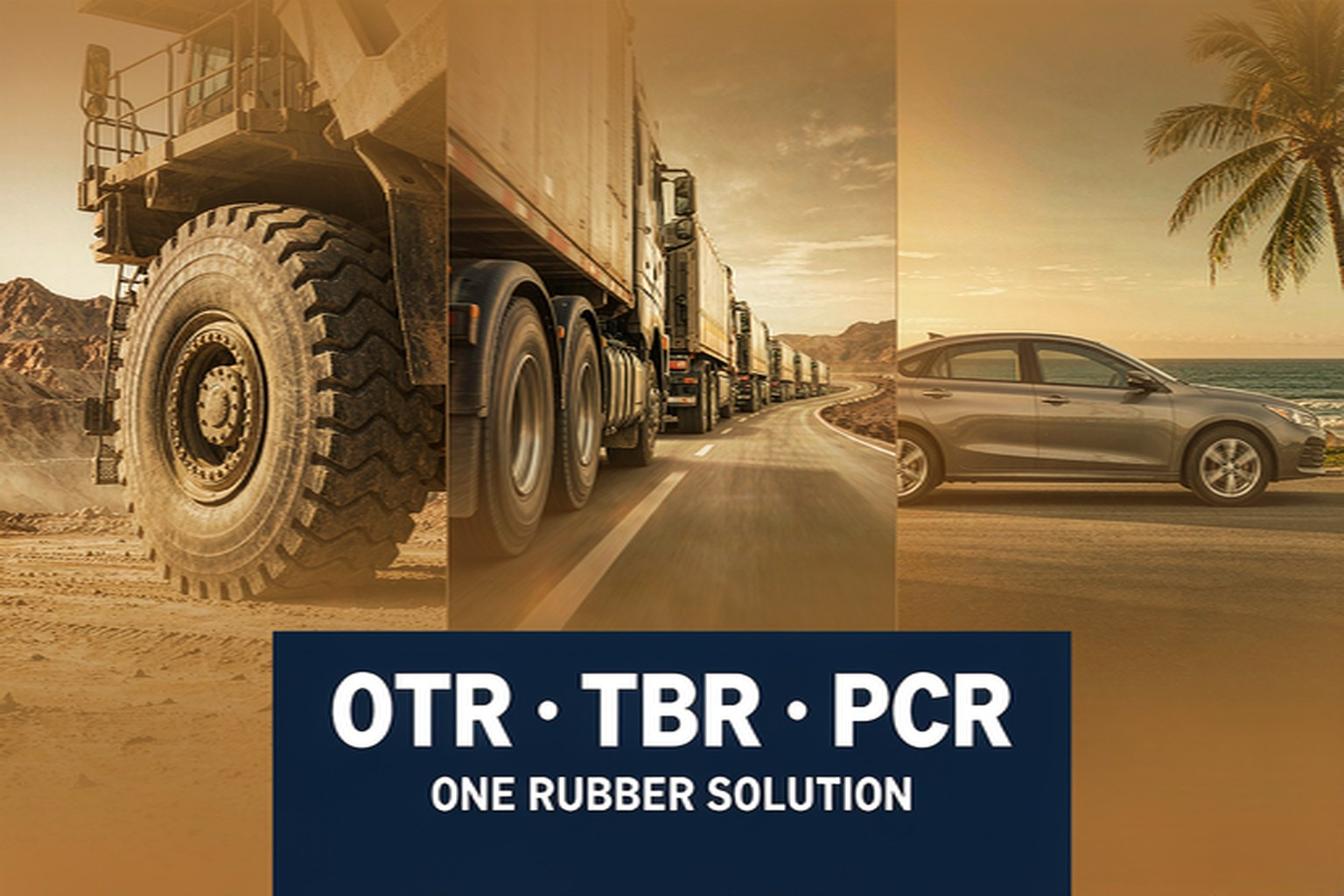
PCR draws the most regulatory attention — consumer-facing, mandatory in INMETRO, G-Mark, NOM, and SNI, with the highest labeling scrutiny. TBR is mandatory in most markets but may sit under commercial-vehicle annexes; a PCR-range G-Mark does not authorize TBR sizes. For commercial procurement planning, the TBR tire price guide covers size-level cost context alongside compliance sequencing. OTR is the most misunderstood: often exempt from passenger-tire conformity programs, but "lighter touch" is not "no requirement" — equipment-import documentation and buyer specifications add their own layers of compliance. The Double Coin OTR tire selection guide maps selection against those requirements.
The structural reason: Western trade remedies differentiate by category. EU AD733 covers only PCR/LTR with load index ≤121 (Source: EU AD733 scope, 2026), and US AD/CVD orders list specific size and category scopes (Source: US AD-CVD orders, 2026). TBR and OTR largely sit outside those nets — but squarely inside destination conformity schemes with their own files.
How to Verify a Tire Certificate Is Real — A 5-Step Supplier Audit
Counterfeit and mismatched certificates are the most common cause of port holds for first-time importers. That is why tire import certification requirements include a verification step, not just a filing step. This audit separates real documentation from decorative PDFs.
Step 1 — Check the Certificate Number on the Issuing Authority's Database
Every legitimate scheme maintains a registry. Use it:
- DOT plant codes resolve to manufacturing plants via NHTSA's product information database (Source: NHTSA) — www.nhtsa.gov
- E-mark approval numbers embed the certifying country code and are verifiable through UNECE (Source: UNECE) — unece.org
- GCC G-Mark certificates can be checked through GSO's certificate-tracking system (Source: GSO) — www.gso.org.sa
- INMETRO and SONCAP records are verifiable through their respective registries (Source: INMETRO; SON) — gov.br/inmetro, son.gov.ng
A supplier who hesitates to give you the certificate number has answered your question.
Step 2 — Match the Certificate to the Exact Factory, Brand, and Size
Certificates name a plant, one or more brands, and a defined size/tread range. If the certificate says "Factory A, Brand X, 205/55R16–225/45R17" and the proforma says "Factory B, Brand Y, 315/80R22.5," nothing in that document stack will clear customs. The common trader pattern: present a genuine certificate from a partner factory while shipping from a cheaper, uncertified plant.
Step 3 — Review ISO Scope and Factory Audit Records
Look for explicit scope wording — "design and manufacture of rubber tires" at the named address. "Trading of automotive parts" means the certificate belongs to a middleman. For schemes requiring factory audits (ECE technical-service audits, INMETRO inspections, GSO assessments), ask when the last audit occurred and what findings closed.
Step 4 — Request Batch-Level Test Reports
Type-approval reports prove a design was tested once. Batch-level reports prove the tires in your container were tested. Ask for the production-run test certificate referencing mold, batch number, or date range. A genuine manufacturer produces batch data in 24–48 hours; a trading company must request it upstream, raising the question of why it was not on file. Corroborate with production capacity and export records.
Step 5 — Commission Third-Party Pre-Shipment Verification
For a mixed TBR/OTR container, an independent inspection body — SGS, Bureau Veritas, Intertek, or regional equivalents — is the cheapest line in this process. A $300–600 inspection fee (Source: inspection agency rate cards, 2026) cross-checks quantity, specification, marking, and document consistency against the purchase order before the doors close. The inspector matches what is inside the container to what the certificates say should be inside.
Beyond certification, supplier-vetting questions are covered in the China tire sourcing FAQ.
2026–2027 Regulatory Shifts That Change Your Sourcing Math
Certification rules do not move in isolation. Trade measures reshape which factories hold which approvals.
Brazil — 30% Import Tax, AD Duties, and the INMETRO Advantage
Brazil's Gecex raised the passenger tire import tax from 25% to 30% effective November 9, 2026. The measure runs through November 9, 2027 (Source: Brazil Gecex, Nov 2026). In late October 2026, Brazil also restarted automatic import licensing (LNA). Anti-dumping duties of $1.25–1.77/kg on Chinese automotive tires have run since December 2025 (Source: Brazil trade remedies, Dec 2025).
January–September 2026, China exported $677 million of tires to Brazil (+30.8%), supplying ~81% of Brazil's passenger tire imports (Source: trade statistics, 2026). Demand is repricing, not leaving. In this environment, INMETRO homologation is a channel-ownership document: new entrants face 3–6 months of approval (Source: INMETRO) while certified importers keep selling through the duty window. For buyers modeling the cost environment beyond certification, see the China tire price increase 2026 buyer playbook.
EU AD733 and Euro 7 — Why Non-EU Buyers Should Still Care
The EU finalized anti-dumping duties on Chinese PCR/LTR (load index ≤121) at 4.3%–45.3% on July 7, 2026, with a countervailing ruling due by December 5, 2026 (Source: European Commission, 2026). Euro 7 tightens material and performance standards for EU-sold tires. You may never ship to Rotterdam, and it still moves your quote. Factories losing European PCR volume reallocate capacity — and quote harder in Lagos, Jeddah and São Paulo. Open production slots and certification-file processing times both shift with it.
US AD/CVD, Section 232, and the Overseas-Factory Fallacy
US measures stack anti-dumping at 87.99% with countervailing duties of 21.68%–116.73%, plus 25% Section 232 on covered products (Source: US trade remedies, 2026). The US also raised duties on Thai PCR from zero to 14.62%–21.09% in 2026 (Source: US trade data, 2026). The overseas-factory fallacy — that shifting production dissolves exposure — ignores that certification follows the manufacturing plant. A new plant means new DOT registration, new type approvals, new factory audits. Budget 2–6 months of re-approval per SKU moved.
EAEU and Other Moving Pieces
The EAEU extended anti-dumping duties on Chinese TBR at 14.79%–35.35% through February 13, 2027 (Source: EAEU), redirecting Central Asian inventory toward the Middle East and East Africa. Smaller moves compound: Indonesia's SNI transition closes July 16, 2026 (Source: SNI); Saudi SABER periodically adjusts shipment-level documents. Treat your certification calendar as a compliance dashboard with renewal dates and deadlines — not a folder opened yearly.
How Goldtop's Certification Matrix Works for Importers
Goldtop Industrial is a China-based tire B2B export specialist built on one principle: the importer should be negotiating price and delivery, not chasing certificates. Our seven-certification matrix — ISO9001, DOT, ECE, GCC G-Mark, INMETRO, CCC, and SONCAP — spans the full product portfolio.
Seven Certifications, One Supplier — ISO9001, DOT, ECE, GCC, INMETRO, CCC, SONCAP
Most importers buy PCR, TBR, and OTR — usually from three suppliers with three compliance desks whose documents never align. Our matrix is built per factory and per brand so one purchase order spans categories without breaking the documentation chain. The Double Coin, Warrior, and Fedcoin brand pages map our portfolio to certification coverage and market fit.
Trial Orders, Mixed Containers, and Pre-Handled Documentation
MOQ is one 20-foot container, and we support mixed-container trial orders — PCR, TBR, and OTR SKUs sharing a single container to validate quality and documentation across categories without three full bookings. For SONCAP, GCC/G-Mark, and INMETRO destinations, we prepare certification documents before the order is confirmed. Our export network reaches 45+ countries across Africa, the Middle East, Southeast Asia, and Latin America (Source: Goldtop, 2026). Browse the full product portfolio across PCR, TBR, and OTR lines.
Certified lines cover all three categories: the Double Coin REM-2 earthmover tire anchors OTR mining and quarry demand; Double Coin RLB1 and RR4 cover TBR drive and trailer positions; Warrior Eco-Max serves the PCR replacement market.
Ready to run a compliant trial order?
One 20-foot container is enough to test both the tires and the paperwork. Contact us with your destination and sizes — we map the scheme, confirm certificate coverage for your exact SKUs, and book the mixed trial. Reservation Now if the plan is already set.
Conclusion
Certification decides whether you are selling into these markets or waiting outside them. It also decides whether the margin on the invoice survives to the bank statement. Verify every certificate against the issuing authority's database and match it to the exact factory, brand, and size before your deposit moves. Choose a supplier whose certification matrix already covers the markets and categories you ship to.
Send us your destination and target sizes. We will audit them against our ISO9001 / DOT / ECE / G-Mark / INMETRO / CCC / SONCAP coverage and come back with what clears, what needs a new file, and what a mixed trial container looks like. Contact Goldtop.
FAQ
Is SONCAP mandatory for tire imports to Nigeria?
Yes — for every commercial tire shipment. Nigeria's SONCAP requires a Product Certificate (PC) against the brand and range, plus a shipment-level Certificate of Conformity (SC) issued before clearance (Source: SON). Ship without an active SC and the container sits.
Can DOT or ECE certification replace INMETRO in Brazil?
No. INMETRO does not accept DOT or ECE test reports as direct substitutes. Brazil requires testing through INMETRO-accredited laboratories and a Brazilian legal entity to hold the certificate (Source: INMETRO). DOT and ECE data can support the file but cannot replace INMETRO approval.
How do I get INMETRO certification for tire imports?
Start with INMETRO-accredited lab testing and a Brazilian legal entity as certificate holder, covering each brand and size family. The approval cycle runs 3–6 months, with ~4-year validity subject to annual review (Source: INMETRO). Book lab slots early and file the homologation request before quoting.
How long does GCC G-Mark tire certification take?
GCC G-Mark tire certification typically takes 4–8 weeks once complete test reports are available, covering factory registration and technical-file review against GSO 2470/2528. The certificate is valid 3 years (Source: GSO). Pre-2021 reports may be rejected because GSO added rolling-noise and wet-grip limits from 2021.
What certifications do I need to import tires to Saudi Arabia?
You need GCC G-Mark conformity under GSO 2470/2528 plus SABER platform registration referencing SASO requirements before shipment release (Source: GSO). Certificates must cover the exact factory, brand, and size range, with bilingual Arabic/English labels and the G-Mark permanently molded on the sidewall.
How can I verify a tire certificate is real?
Check the number on the issuing authority's database (NHTSA/UNECE/GSO). Match factory, brand, and size scope to the shipment. Then review the ISO scope, pull batch-level test reports, and commission a pre-shipment inspection if the container mixes categories (Source: NHTSA; UNECE; GSO).
Do OTR tires need the same certifications as PCR tires?
Not exactly. OTR tires are often exempt from passenger-tire conformity programs or subject to lighter inspection, but equipment-import documentation and buyer specifications still apply. TBR and OTR also largely sit outside Western AD/CVD scopes (Source: EU AD733 scope; US AD-CVD orders, 2026), so duty and certification paths differ from PCR.


Have a question ? We are here to help.



Tire Inquiry Form
Name*
Phone*
Email*
Leave word*


